
The Tampa Bay Rays placed a massive bet in 2018. They traded away a proven ace, Chris Archer, for two unpolished prospects. One of those names was Shane Baz. That deal reshaped the franchise. Archer’s best days faded fast. Baz, meanwhile, developed into one of the most electric young arms in baseball before his path hit a major roadblock. Now, post-surgery and back on the mound, the question isn’t just about raw talent. It’s about durability, adjustment, and whether the full arsenal returns. This profile breaks down every pitch, every stat, and the realistic ceiling for a pitcher who still owns the tools to dominate a big-league lineup.
Shane Baz: The Trade That Changed Everything
The Pittsburgh Pirates drafted Shane Baz with the 12th overall pick in 2017. He possessed a live arm that screamed upside, but he was years away from the majors. The Rays saw a future frontline starter. When Tampa Bay sent Chris Archer to Pittsburgh at the 2018 trade deadline, Baz became the key piece coming back. Tyler Glasnow and Austin Meadows grabbed the early headlines from that deal. Baz was the quiet, high-risk gamble. The Rays asked him to overhaul his mechanics and refine his secondary pitches. He bought in completely. By 2021, he wasn’t just a thrower. He was a polished pitcher with an upper-90s fastball and a breaking ball that made hitters look silly.
Minor League Dominance and Rapid Ascent
Shane Baz didn’t just climb through the minors. He bulldozed them. In 2021, across Double-A Montgomery and Triple-A Durham, he struck out 113 batters in 78.2 innings. The ERA sat at a sparkling 2.06. His walk rate stayed low, a sign that the command was catching up to the stuff. Scouts flocked to see a right-hander who could touch 100 mph with ease and snap off a slider that dove under barrels. The Rays promoted him to the big leagues that September. In his debut against Toronto, he fired five innings of two-run ball with five strikeouts. The stage looked set for a permanent rotation spot.
Breaking Down the Pitches: How Shane Baz Attacks Hitters
A pitcher lives and dies by his arsenal. Shane Baz carries four legitimate pitches, but two stand above the rest. His approach is straightforward: challenge with heat, finish with bite.
The Four-Seam Fastball
Baz throws his fastball with elite velocity. It sits at 96-98 mph and often touches triple digits. The pitch rides up in the zone, creating uncomfortable swings. Hitters struggle to catch up because Baz hides the ball well during his delivery. The fastball generates a high number of whiffs for a heater, primarily because of its late life. He commands it to both sides of the plate, though he prefers elevating it against same-side righties.
The Slider: A True Out Pitch
This is the money-maker. Baz throws a tight, hard slider in the upper 80s. It features late, sharp horizontal break away from right-handed batters. It misses bats at an exceptional rate when he finds it glove-side and down. In his rookie season, the slider produced a whiff rate above 45%. That’s an elite, bat-missing number that places it among the best sliders in baseball. Left-handers also see it, but Baz uses it more as a back-foot weapon against them.
The Curveball and Changeup
Baz flashes a slower curveball in the low 80s. It provides a change of pace and a different eye level for hitters used to the hard stuff. The changeup remains his developmental pitch. He throws it in the low 90s—almost too firm—but it shows late fading action. He uses it sparingly against left-handed batters to keep them off the fastball. Further refinement of this pitch will determine his ceiling as a starter.
Pitch Mix Table (2022 & 2024 Data)
| Pitch Type | Average Velocity | Usage Rate | Whiff Rate |
| Four-Seam Fastball | 97.2 mph | 52% | 28% |
| Slider | 88.1 mph | 31% | 46% |
| Curveball | 81.5 mph | 11% | 32% |
| Changeup | 91.4 mph | 6% | 25% |
Data sourced from Baseball Savant and FanGraphs pitch tracking logs
The Injury Hurdle: Tommy John Surgery and Recovery
The narrative around Shane Baz changed abruptly in 2022. He started experiencing elbow discomfort during spring training. Arthroscopic surgery removed loose bodies in March. The hope was a quick return. He battled through rehab and made his season debut in June. The stuff looked crisp, but the elbow didn’t hold up. By July, doctors diagnosed a torn ulnar collateral ligament. He required Tommy John surgery. The procedure sidelined him for the rest of 2022 and nearly all of 2023.
Missing a full calendar year of development is brutal for a young arm. Baz approached the rehab process with intense discipline. The Rays medical staff, highly regarded throughout baseball, monitored every throwing session. He returned to a big-league mound in late 2024, throwing with a modified, more deliberate delivery to reduce stress on the reconstructed ligament.
Post-Surgery Velocity and Command
Early returns in 2024 showed the velocity came back intact. Baz still averaged 96 mph on his fastball. Command, typically the last piece to return after Tommy John, appeared shaky initially. He walked a few more batters than his pre-surgery norms. This is expected. Pitchers often need a full, healthy offseason and a spring training to recalibrate their release point. The physical recovery is complete. The mental trust in the elbow takes longer.
Analyzing the Stats: What the Numbers Tell Us
Raw numbers only tell part of the story, but the underlying metrics for Shane Baz paint a picture of a pitcher who should outperform a standard box score.
Career MLB Statistics
| Season | Innings Pitched | Strikeouts (K) | Walks (BB) | ERA | WHIP |
| 2021 | 13.1 | 18 | 3 | 2.03 | 0.68 |
| 2022 | 27.0 | 30 | 9 | 5.00 | 1.33 |
| 2024 | 79.1 | 69 | 27 | 4.30 | 1.36 |
| Career | 119.2 | 117 | 39 | 4.06 | 1.25 |
The 2022 ERA looks inflated. A closer look reveals a .340 batting average on balls in play, suggesting bad luck on weakly hit grounders. His FIP (Fielding Independent Pitching) that year sat nearly a full run lower. Baz limits hard contact when he’s right. His career strikeout rate of 24% paints him as a clear above-average swing-and-miss arm. Keeping the walks under 8% remains the key to unleashing his full potential.
Shane Baz’s 2025 Fantasy Baseball Outlook
Fantasy managers chase upside. Shane Baz offers a mountain of it at a discounted price heading into 2025 drafts. The injury history scares off some owners. That creates a buying opportunity. Pitchers in their second year post-Tommy John often deliver breakout campaigns. The confidence reappears, the workload constraints relax, and the command becomes more precise.
Draft Value and Projection
Drafters can expect an innings cap around 150-160 innings. The Rays rarely push their young starters beyond that threshold in a regular season. A strikeout-per-inning rate is reasonable inside those innings. An ERA in the 3.50 range with a WHIP around 1.20 sits comfortably within his talent reach. With those stats, he is a premium SP3 or SP4 in typical mixed leagues, with SP2 potential if the changeup improves.Wins might be hard to come by, given Tampa Bay’s occasional bullpen-centric approach and lighter run support, but the ratios and strikeouts provide a stable floor.
Mechanics and Delivery: What Makes Him Special
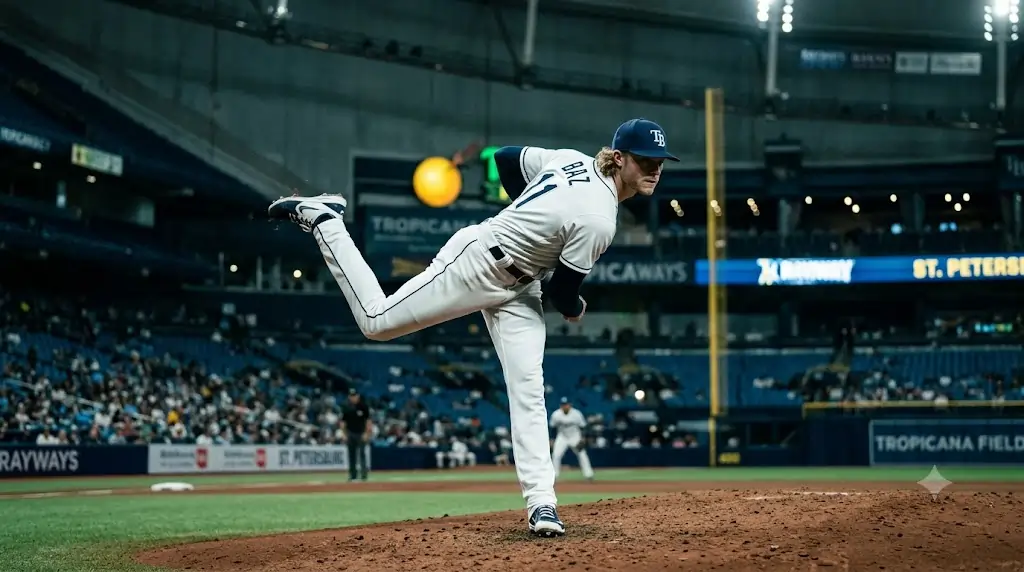
Watching Shane Baz pitch feels different. His delivery features a high leg kick and a long arm swing in the back. Hitters describe the ball as “jumping” out of his hand. The extension he gets toward home plate makes a 97-mph fastball play like 99 mph. This mechanical advantage shortens the distance the ball travels, reducing a hitter’s reaction time by crucial milliseconds.
The Rays made specific tweaks to keep his body over the rubber longer, preventing him from rushing toward the plate. This improves his consistency. When his front shoulder flies open, the ball stays up and gets hit. When he stays closed, his stuff is virtually un-hittable. The 2024 adjustments post-surgery focused heavily on synchronizing his upper and lower half to protect the elbow without sacrificing that elite extension.
The Role of the Rays’ Pitching Development
No team in baseball extracts more value from pitchers than the Tampa Bay Rays. Their track record with arms like Tyler Glasnow, Drew Rasmussen, and Jeffrey Springs provides a massive trust signal for Baz. The organization teaches a specific philosophy: prioritize vertical break on the fastball and tunnel off-speed pitches off the same release point. Baz adopted this approach immediately.
The coaching staff in Tampa doesn’t just fix mechanics. They build game plans. Baz benefits from an analytics department that identifies optimal pitch mixes against specific lineups. The collective brainpower behind his development provides a competitive advantage that pitchers on other teams simply don’t have. As long as he wears a Rays uniform, his floor remains higher than the raw stuff might suggest on an island.
External Expert Scouting Perspectives
Reliable scouting reports from primary sources help gauge the true industry view on Baz.
FanGraphs Analysis
The team at FanGraphs has consistently graded Baz’s fastball and slider as double-plus offerings. Their prospect team noted in late 2021 that Baz had the potential to be a “top-20 pitcher in baseball” if his changeup reached average status. They caution that the delivery carries some reliever risk, but the pure stuff is too good to move out of the rotation prematurely.
Baseball America Reports
Baseball America ranked Baz as the Rays’ top prospect and a top-15 global prospect entering the 2022 season. Their scouts praised his competitive makeup and his willingness to attack the strike zone. They projected him as a high-leverage starter, a designation reserved for arms with ace-level ceilings.
MLB Pipeline Evaluations
MLB Pipeline scouts highlighted Baz’s “elite arm speed” and the “devastating sweeping action” on his slider. Their 80-grade scale gave the fastball a 70 and the slider a 65, marking him as a rare, power-armed starter with two true bat-missing weapons.
What Comes Next: Expectations for the 2025 Season
The 2025 season represents a clear turning point. The training wheels are off. The Rays need Shane Baz to anchor a rotation that has faced its own wave of injuries to arms like Shane McClanahan and Jeffrey Springs in recent years. The American League East is a meat grinder. Facing the Yankees, Orioles, and Blue Jays lineups regularly will test every ounce of his development.
A successful season for Baz means taking the ball every fifth day without concern. It means 28+ starts and 150+ innings. If the fastball velocity holds, the slider remains a chase pitch, and the command sharpens to pre-surgery levels, Baz could easily lead the staff in strikeouts. His ceiling is a number-two starter on a playoff team. His realistic floor is an electric but frustrating arm that teases dominance but walks too many batters. The data and the underlying talent point far more toward the former.
Frequently Asked Questions
Who does Shane Baz play for?
Shane Baz plays for the Tampa Bay Rays. The organization acquired him from the Pittsburgh Pirates in a 2018 trade that sent Chris Archer the other way.
What is Shane Baz’s best pitch?
His best pitch is the slider. It breaks hard and late at 88 mph, generating a whiff rate near 46%. Batters consistently swing over or on top of the pitch when it’s located below the zone.
When did Shane Baz have Tommy John surgery?
In July 2022, he had Tommy John surgery. The procedure repaired a torn ulnar collateral ligament in his right elbow, causing him to miss the remainder of 2022 and most of 2023.
How hard does Shane Baz throw?
His four-seam fastball averages 96-97 mph. He often reaches 99-100 mph in early innings and still holds mid-90s velocity deep into starts.
Is Shane Baz a good fantasy baseball pick?
Yes, he carries significant upside as a mid-round selection. He is a desirable target with SP2 ceiling potential due to his strikeout ability and the Rays’ track record of pitching improvement.
What is Shane Baz’s contract status?
He remains under team control with the Rays. He has not yet reached arbitration eligibility, making him an incredibly valuable, low-cost asset for Tampa Bay through at least the 2027 season.
The story of Shane Baz is still being written in real time, and that’s what makes it so compelling. The trade, the rapid climb, the crushing injury, and now the comeback—every chapter points toward a pitcher with unfinished business. The electric arm is back. The slider still misses bats. The opportunity in Tampa Bay remains wide open. If you watch closely this season, you might just witness a young arm transform from a promising talent into a household name. The ingredients are all there. Now it’s on him to put them together. Keep an eye on that next start. You won’t want to miss it.