
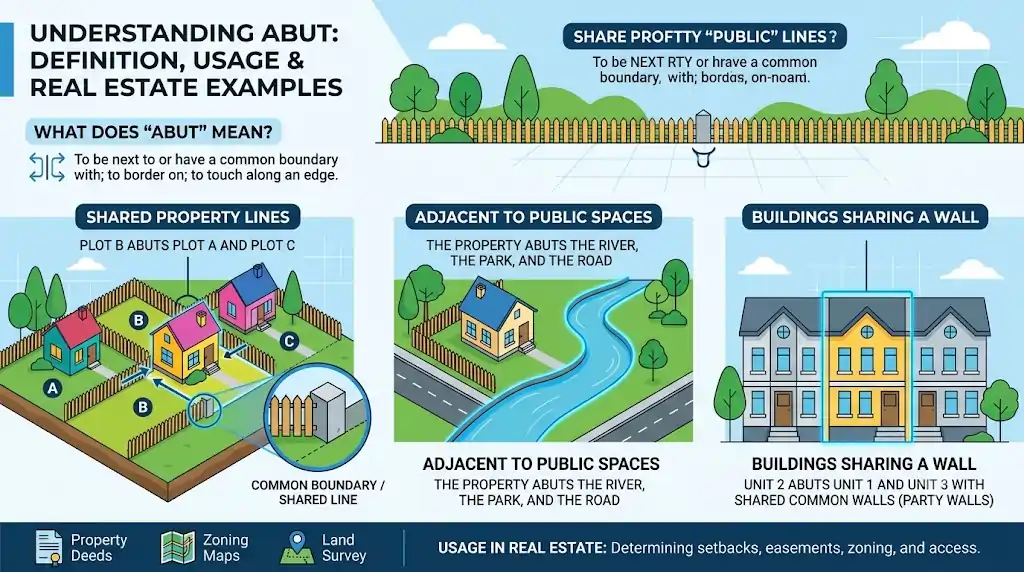
My neighbor planted a row of maple trees exactly where our properties meet. When I asked about trimming overhanging branches, he pointed to the survey stakes and said, “Our lots abut meaning right here.” I nodded like I understood. Truthfully, I had no idea what that word meant. If you stumbled across abut meaning in a legal document, property listing, or conversation and felt the same confusion, you landed in the right place. This guide explains the complete abut meaning without the jargon fog.
What Does Abut Meaning? A Simple Starting Definition
Abut means to touch or lean against something along a shared edge or boundary. Think of two puzzle pieces clicking together. Each piece abuts the other where their edges meet.
The word appears most often in real estate and legal contexts. One property abuts another when their boundary lines share a common edge. A building abuts a sidewalk when its wall sits directly against the concrete. A driveway abuts a garage when the pavement meets the foundation.
The Merriam-Webster dictionary defines abut as “to touch along a border or with a projecting part.” The Cambridge Dictionary adds clarity with “to be next to or have a common boundary with something.” Both sources emphasize the physical connection at a specific edge or point.
Breaking Down the Word: Origins and Etymology
Abut meaning traces back to the Old French word “abouter,” meaning to join end to end. Medieval Latin gave us “abuttare,” combining “ad” (to) and “buttare” (to strike or push). The English language absorbed abut during the 15th century, first appearing in legal documents related to land ownership and property boundaries.
| Language Stage | Word Form | Meaning |
| Latin | Ad + Buttare | To push toward, to strike against |
| Old French | Abouter | To join end to end, to touch at the boundary |
| Middle English | Abutten | To touch at one end, to border upon |
| Modern English | Abut | To share a common boundary or edge with |
Linguists classify abut as a verb that always requires a direct object or prepositional phrase. You cannot simply say “the property abuts.” You must specify what it abuts—a road, another property, a river, or a structure. This grammatical requirement reflects the word’s fundamental purpose: describing relationships between adjacent things.
How to Use Abut meaning Correctly: Practical Examples
Using abut correctly becomes simple once you understand its pattern. The word always needs a target object. Here are practical examples that demonstrate proper usage across different contexts:
Real Estate Context:
- “The eastern boundary of Lot 7 abuts a protected wetland area.”
- “Their backyard abuts the community golf course.”
- “Three sides of the commercial building abut public roadways.”
Legal Documents:
- “Along its northern boundary, the lot borders state-owned land.”
- “The easement abuts the property line for approximately 200 feet.”
Everyday Conversation:
- “My desk abuts the window, so I get excellent natural light.”
- “The new fence abuts the old stone wall near the garden gate.”
Abut meaning always describes a physical edge-to-edge relationship. Do not use it for things merely located near each other. A house across the street does not abut your property. A house sharing your boundary line does.
Abut meaning in Real Estate: Property Lines and Boundary Matters
Real estate professionals use abut constantly. Property deeds, title reports, and survey documents all rely on the term to define exactly where one piece of land ends and another begins.
Abutting properties share legal responsibilities. When two lots abut each other, owners typically split fence maintenance costs. When a property abuts a public road, the municipality usually handles sidewalk repairs. When land abuts a waterway, specific regulations govern usage rights and environmental protections.
The National Association of Realtors emphasizes that understanding boundary relationships prevents disputes before they start. An experienced agent verifies exactly what each listed property abuts. Adjacent features affect property values, insurance costs, and development potential.
The American Land Title Association requires precise boundary language in all insured title documents. Surveyors mark exactly where properties abut meaning using permanent monuments and detailed maps. A small boundary error can create major legal problems.
Legal Usage: Contracts, Easements, and Property Rights
Legal documents employ abut with surgical precision. The word appears in easement agreements when one property owner needs access across another’s land. It shows up in zoning regulations when municipalities define setback requirements from abutting properties.
Black’s Law Dictionary defines abut in legal terms as “to reach or touch at the end; to be contiguous; to join at a boundary or border.” This definition carries binding legal weight in court decisions involving property disputes.
An attorney representing a client in a boundary dispute must prove exactly where properties abut. Survey reports, historical deeds, and physical markers all establish the precise location. The legal abut meaning determines who owns trees on the line, who maintains shared driveways, and who bears responsibility for retaining walls.
Abut Versus Adjacent: Understanding the Important Difference
People confuse abut with adjacent regularly. The distinction matters because legal rights change based on physical contact. Two properties can sit adjacent to each other—nearby, neighboring, in the same area—without actually abutting. Abutting properties physically touch. Adjacent properties do not necessarily touch.
| Feature | Abut | Adjacent |
| Physical Contact | Required, properties touch directly | Not required, properties are simply near each other |
| Shared Boundary | Yes, a common edge or line exists | Not necessarily, can be separated by other properties or spaces |
| Legal Implications | Creates shared responsibilities for boundaries | Creates fewer direct legal obligations |
| Common Usage | Legal documents, surveys, title reports | General descriptions, neighborhood overviews |
| Example | “The garage abuts the house” | “The park sits adjacent to the school” |
Understanding this distinction saves money during property transactions. An agent might describe a home as adjacent to open space. Adjacent does not guarantee that open space touches the property. Abut does guarantee physical contact. The difference affects privacy, development risk, and long-term enjoyment of the land.
Architectural and Construction Usage of Abut
Architects and builders use abut to describe structural connections. A roof abuts a chimney when the shingles meet the brickwork. Flooring abuts baseboards where the horizontal surface meets the vertical trim. Countertops abut walls along the backsplash line.
The American Institute of Architects specifies abutment joints in construction documents. These joints require proper sealing and flashing to prevent water intrusion. When two different materials abut each other—wood against concrete, metal against stone—builders install transition strips to manage expansion and contraction.
Construction specifications reference ASTM International standards for abutment connections. Proper installation at these junction points prevents structural failures, water damage, and aesthetic problems. Every professional builder understands that where materials abut, potential problems concentrate.
Environmental and Conservation Applications
Environmental regulations use abut to define jurisdiction over sensitive areas. Wetlands protection laws apply to properties that abut designated water bodies. Coastal zone management regulations affect land abutting beaches and tidal areas. Conservation easements frequently reference abutting parcels to establish protected corridors.
The Environmental Protection Agency enforces rules based on what properties abut. Stormwater management requirements differ for land abutting waterways versus land with no direct water contact. Developers must account for these regulatory differences before breaking ground.
The U.S. Fish and Wildlife Service maps critical habitat that abuts private land. Property owners whose land abuts protected areas face specific usage restrictions designed to preserve wildlife corridors and water quality.
Common Mistakes People Make With Abut
Using abut without an object
Wrong: “The two properties abut.”
Right: “The two properties abut each other.”
Confusing abut with adjoin
Adjoin means to be next to but may or may not involve touching. Abut requires direct contact. Use abut for precision.
Applying abut to non-physical things
Wrong: “His opinion abuts mine.”
Right: “His opinion aligns with mine.” Abut describes physical edges, not abstract concepts.
Spelling errors
The word has one “t” at the end. Abutted and abutting double the “t” in past tense and participle forms.
Synonyms and Related Terms for Better Understanding
Expanding your vocabulary around abut helps with comprehension of legal and property documents:
- Border: A line separating two areas, synonymous with boundary
- Verge: An edge or border, often used for roadside boundaries
- Adjoin: To be next to, though not necessarily touching
- Contiguous: Sharing a common border, essentially identical to abutting
- Butt against: An informal phrase meaning exactly what abut means formally
Frequently Asked Questions
What does abut mean in simple terms?
Abut means that two things touch each other along a shared edge or boundary. Properties abut when their land physically touches. A building abuts a sidewalk when the wall meets the concrete directly.
How do you use abut in a sentence about property?
You use abut with an object that receives the action. Example: “The southern boundary of the farmland abuts a state highway.” Always specify what the property touches.
What is the difference between abut and adjoin?
Abut requires direct physical contact along a boundary. Adjoin means things are next to each other but may not actually touch. Legal documents prefer abut for its precision.
Where does the word abut originate from?
Abut comes from Old French “abouter” and Medieval Latin “abuttare.” These root words mean to push against or join end to end. English adopted the term during the 15th century.
Why do real estate agents use abut so frequently?
Real estate agents use abut because property boundary descriptions require exact language. The word eliminates ambiguity about which features physically touch a parcel of land.
What responsibilities come with abutting properties?
Abutting property owners typically share boundary maintenance duties. Fences, walls, and drainage systems along shared property lines usually require cooperation between neighbors.