
Introduction
Let me tell you a secret. The difference between a tough, chewy steak and one that melts like butter on your tongue is just a few numbers on a thermometer.
I have cooked thousands of steaks. On gas grills, charcoal, cast iron, and even campfires. I have ruined expensive cuts and I have nailed cheap ones. And here is the truth: temperature is everything.
If you want that beautiful, warm red center that squeaks when you bite it? You need the medium rare steak temp. Not a guess. Not a timer. Not a finger poke.
In this guide, I will teach you exactly how to hit 135°F every single time. We will cover the science, the tools, the tricks, and even the mistakes that ruin steaks. No complicated jargon. Just real talk from someone who has burned their fingers more times than they count.
Ready to cook like a steakhouse? Let’s fire up that pan.
What Exactly Is Medium Rare Steak Temp?
Let us get this straight right now. Medium rare steak temp is not one number. It is two.
You have the temperature inside the pan. And you have the temperature after the steak rests. They are different. And this is where most home cooks fail.
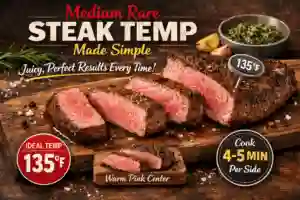
When experts talk about medium rare steak temp, they mean the final internal temperature after resting. That magic number is 135°F (57°C) .
But here is the trick. You must pull the steak off the heat earlier. Way earlier. At around 130°F (54°C) .
Why? Because meat keeps cooking after you take it off the fire. This is called carryover cooking. The hot juices near the surface travel inward. The temperature rises another 5 to 8 degrees.
So if you wait until your steak reads 135°F on the grill? Congratulations. You just cooked a medium steak.
Medium rare steak temp is about anticipation. You stop cooking before it is done. Then you wait. And that patience rewards you with the most beautiful, rosy, juicy center you have ever seen.
Why Medium Rare Steak Is the Gold Standard
Have you ever wondered why chefs fight over medium rare steak like it is sacred? It is not snobbery. It is science.
When beef cooks, two things happen. First, the fat renders. Second, the muscle fibers tighten.
At lower temperatures, the fat stays solid. The meat is cold and chewy. At higher temperatures, the fat melts away and the muscle squeezes out all the moisture. You get dry, gray meat.
But medium rare steak sits right in the sweet spot. The fat has softened into liquid gold. The proteins have relaxed just enough. And the moisture? Still trapped inside that beautiful red center.
Here is what you actually taste when you hit the medium rare steak temp:
Butter. Not added butter. The beef’s own fat, melted and coating your tongue.
Iron. That clean, mineral taste of fresh red meat.
Umami. The savory depth that makes steak addictive.
Juice. Not blood. Never blood. Myoglobin and water, released with every bite.
I have served well-done steaks to guests who swore they hated pink meat. After one bite of proper medium rare steak? They never looked back.
The Complete Steak Temperature Chart for Home Cooks
I am giving you the exact numbers I use in my own kitchen. These are tested, tasted, and trusted. Print this. Save it on your phone. Tape it inside your cabinet.
Steak Doneness Chart: Pull vs. Final Temp
| Doneness Level | Pull Off Heat At | Final Serving Temp | Center Description | Best For Cuts |
|---|---|---|---|---|
| Rare | 120°F (49°C) | 125°F (52°C) | Deep red, cool center, very soft | Tenderloin, Filet Mignon |
| Medium Rare | 130°F (54°C) | 135°F (57°C) | Warm red center, very juicy, buttery texture | Ribeye, Strip, Sirloin, Most cuts |
| Medium | 140°F (60°C) | 145°F (63°C) | Pink center, firmer, less juice | Some lean cuts, picky guests |
| Medium Well Steak | 150°F (65°C) | 155°F (68°C) | Slight pink, mostly gray, drier | Family members who fear red meat |
| Well Done | 160°F (71°C) | 165°F (74°C) | No pink, fully gray, firm | Only if you must |
Notice something? Medium rare steak temp is the widest window. It is the most forgiving. And it is the most flavorful.
For medium steak temp, you let it go about ten degrees higher. The pink gets lighter. The juice starts escaping. It is still good steak. But it is not great steak.
And medium well steak? That is the edge of the cliff. One degree too high and you have a hockey puck.
How to Check Medium Rare Temp Without Ruining Your Steak
I meet people who refuse to use thermometers. They tell me they “just know.” And you know what? Half the time, they overcook it.
Here is my rule. Thermapen users eat better steak than finger-pokers. Every single time.
The Right Tool
Buy a good instant-read thermometer. Not the analog dial one your dad used in 1995. Those take ten seconds to read. By the time it beeps, your steak has lost five degrees and your wife is asking when dinner is ready.
Get a thermocouple or high-speed digital thermometer. It reads in two seconds. It is accurate. It pays for itself in one steak dinner.
The Right Technique
- Insert from the side. Not the top. You want the probe tip in the exact center of the thickest part.
- Go slowly. Push until you feel resistance, then pull back a millimeter.
- Read the number. Compare to our medium rare steak temp goal of 130°F.
- Clean your probe between steaks. Yes, even if it seems fine.
The Touch Test Myth
You have seen chefs poke their steak and touch their thumb. It looks cool. It impresses guests. But it is unreliable.
The palm of your hand changes firmness based on your blood pressure, your age, and how tight you squeeze. Plus, a cold raw steak feels different than a hot cooked one.
Use a thermometer. Be proud of it. Real experts use tools.
Carryover Cooking: Why Your Steak Keeps Cooking
This is the single biggest mistake I see. Someone pulls a beautiful ribeye at exactly 135°F medium rare steak temp. They set it on the cutting board. They smile. They take a photo.
Five minutes later? It is medium. Maybe medium well. The pink is fading. The plate has a puddle of juice.
Carryover cooking stole their dinner.
Here is the math. Thick steaks carry more heat. Hot pans carry more heat. Bone-in steaks carry more heat. And the longer you rest, the more the temperature equalizes.
For a standard 1.5-inch steak cooked hot and fast:
Pull at 125°F for rare final.
Pull at 130°F for medium rare steak temp final.
Pull at 135°F for medium final.
If you reverse-sear or cook low-and-slow? The carryover is smaller. Maybe only two degrees. Adjust accordingly.
The solution is simple. Do not trust the temperature on the grill. Trust the temperature after rest.
Pan-Seared Ribeye: A Step-by-Step Recipe
I cook ribeye more than any other cut. Why? Fat. That beautiful marbling melts at medium rare steak temp and creates its own sauce.
Ingredients:
- One bone-in ribeye, 1.5 inches thick
- Kosher salt (Diamond Crystal preferred)
- Fresh cracked black pepper
- Avocado oil (high smoke point)
- 3 tablespoons unsalted butter
- 4 garlic cloves, smashed
- 2 sprigs fresh rosemary
- 2 sprigs fresh thyme
Step 1: Salt Early
Pat the steak dry. Salt generously on all sides. Place on a wire rack in the fridge. Leave it uncovered for at least 45 minutes. Overnight is better. This dries the surface and seasons deep.
Step 2: Bring to Room Temp
Pull the steak 30 minutes before cooking. Do not skip this. A cold center will ruin your medium rare steak temp timing.
Step 3: Heat the Pan
Cast iron is best. Set over medium-high heat for five full minutes. Add oil. It should shimmer and ripple immediately.
Step 4: Sear and Flip
Lay the steak away from you. Press gently. Listen to that sizzle. Flip every 45 seconds. This builds crust faster than one long sear.
Step 5: Butter Baste
At 115°F, add butter, garlic, herbs. Tilt the pan. Spoon hot butter over the steak constantly for 60 seconds.
Step 6: Pull and Rest
At 130°F on the dot, remove steak. Place on cutting board. Pour butter on top. Rest 8 to 10 minutes.
Step 7: Slice and Serve
Cut against the grain. Sprinkle with flaky salt. Watch your guests close their eyes.
Common Mistakes That Ruin Medium Rare Steak Temp
I have made every mistake on this list. Some multiple times. Learn from my failures.
Mistake 1: Cooking Cold Steak
You pull steak from fridge. You throw it in pan. The outside burns. The inside is blue. You check medium rare steak temp at the center and it reads 95°F. Now you are panicking. You leave it on too long. The crust turns to charcoal. Give it 30 minutes on the counter. Please.
Mistake 2: Flipping Once
The old school says flip once. This is wrong. Frequent flipping cooks more evenly and builds better crust. Flip every 45 to 60 seconds. I promise your steak will not break.
Mistake 3: Trusting the Color
Color lies. Sometimes a steak looks perfectly pink but feels tough. Sometimes it looks gray but is actually medium rare steak temp. Why? Myoglobin content varies by cut, age, and pH. A thermometer never lies.
Mistake 4: Cutting Too Soon
I know it smells amazing. I know everyone is hungry. But cutting open a resting steak releases all those juices onto the board instead of into your mouth. Wait eight minutes. Set a timer.
Mistake 5: Thin Steaks
You cannot properly hit medium rare steak temp on a half-inch thin cut. By the time the surface sears, the center is well done. Buy thick steaks. At least one inch. Preferably 1.5 inches.
Grill vs. Cast Iron vs. Oven: Best Method for Medium Rare
I own a fancy grill. I also own a forty-dollar cast iron pan. Guess which one I use more often?
Cast Iron Skillet
Best for crust. The entire surface contacts the meat. You get that dark, crackly bark. Easy to baste with butter. Perfect for apartment cooks. Only downside? Smoke. Open a window.
Gas or Charcoal Grill
Best for flavor. Smoke kisses the meat. Fat drips on coals and vaporizes. You get that backyard BBQ taste. Harder to baste. Harder to check medium rare steak temp with ambient heat.
Oven Reverse-Sear
Best for precision. You cook the steak low and slow at 225°F until it hits 125°F internally. Then you sear it blazing hot for 60 seconds per side. Almost impossible to overcook. Perfect for thick cuts.
Sous Vide
Best for zero stress. Vacuum seal. Water bath at exactly 135°F medium rare steak temp final. Leave it for one hour or four hours. Then sear for 45 seconds. Foolproof. But it takes longer and requires special gear.
My personal favorite? Reverse-sear for thick steaks. Cast iron for thin steaks. Grill for when the weather is nice.
What About Other Meats and Eggs?
You clicked here for medium rare steak temp. But maybe you are cooking other things too. Let me connect the dots.
Medium Steak Temp
This is 145°F final. Slightly more pink than brown. Firmer bite. Good for sirloin or for guests who claim they dislike red meat.
Medium Well Steak
155°F final. Trace of pink. Very little juice. Some people request this. I smile and cook it for them. Then I cook my own steak separately.
Over Medium Eggs
These are not steak. But you asked about over medium eggs in your keywords. Here is the connection. Over medium eggs have runny yolks but fully set whites. You cook them low and slow. Just like a reverse-seared steak. Control the heat. Be patient. Do not rush.
The Temperature Link
Egg whites set at 165°F. Yolks thicken at 150°F. So you must cook eggs gently. High heat ruins them. Same principle applies to delicate foods. Not all cooking is about blasting heat.
The Complete Guide to Steak Doneness Descriptions
Let me paint you a picture of what each level actually looks like.
Rare (125°F)
Cool red center. Very soft, almost raw texture. Meat yields easily to pressure. Not for everyone, but purists love it.
Medium Rare (135°F)
Warm red center. Deep pink from edge to edge. Very juicy. Meat offers slight resistance then gives way. This is the sweet spot.
Medium (145°F)
Hot pink center. Lighter color. Firmer texture. Juice still present but less abundant. Acceptable.
Medium Well (155°F)
Slight pink blush. Mostly brown or gray. Little juice. Meat feels dense. At this point, consider a different cut with more fat.
Well Done (165°F+)
No pink. Fully brown. Dry. Tight grain. You need sauce. Lots of sauce.
If you read restaurant menus and see descriptors like “baseball steak” or “Pittsburgh rare,” those refer to crust color, not internal temp. Pittsburgh rare is charred outside, rare inside. That is just medium rare steak temp with extra crust.
Why Your Thermometer Reading Might Be Wrong
You bought a thermometer. You inserted it. It says medium rare steak temp. You cut into the steak. It is overdone. What happened?
Problem 1: You Hit Bone
Bone conducts heat differently. If your probe touches bone, you get a false high reading. Insert from the side, away from bone.
Problem 2: You Hit Fat
A pocket of fat reads hotter than muscle. Pull back and reinsert into solid meat.
Problem 3: Shallow Insertion
The tip must be in the dead center. If you only push halfway, you read the hot outer layer, not the cool middle.
Problem 4: Dirty Probe
Oil or residue insulates the sensor. Wipe clean between every steak.
Problem 5: Slow Thermometer
Cheap thermometers lag. By the time the number stabilizes, the steak has continued cooking. Spend thirty dollars on a fast one.
I carry a Thermapen in my knife roll. I have owned it for eight years. It has never failed me. Not once.
Frequently Asked Questions
Is 135°F the perfect medium rare steak temp?
Yes. 135°F after resting gives you that warm red center with maximum juice. Some chefs prefer 130°F for a cooler red center. Both are correct. Find your preference.
Can I cook medium rare steak in the oven only?
Yes. Sear first in a pan, then finish in a 375°F oven until internal temp hits 130°F. Rest and serve. This is how steakhouses handle volume.
Why is my steak tough even at medium rare temp?
You either bought a tough cut or sliced it wrong. Flank, skirt, and round need thin slicing against the grain. Ribeye and strip should be tender regardless.
How long should I rest a steak for medium rare?
Rest at least five minutes. Eight is better. Ten for thick cuts. Tent loosely with foil. Do not wrap tightly or you steam the crust.
What is the best cut for medium rare steak?
Ribeye. The fat marbling keeps it juicy. NY strip is second. Filet mignon is leaner but very tender.
Can I reheat medium rare steak without overcooking?
Yes. Use low heat. 250°F oven for ten minutes. Or sous vide at 130°F for twenty minutes. Never microwave.
Is medium rare steak safe to eat?
Yes. Whole muscle beef is safe at 135°F. Bacteria live on surfaces, not inside. The seared crust kills surface pathogens. Ground beef is different. Cook that to 160°F.
What temperature is over medium eggs?
Over medium eggs are cooked until whites are fully set and yolks are thickened but still runny. Low heat, covered pan, about three minutes.
Final Thoughts: Trust Yourself, Trust the Temp
I have given you the numbers. I have shown you the techniques. I have confessed my own burnt fingers and overcooked dinners.
But here is the real secret. Medium rare steak temp is not about perfection. It is about connection.
When you stand at that stove. When you feel the heat on your face. When you slide the probe into the center and watch the numbers climb. You are not just cooking. You are creating something.
That steak on the board. The butter pooling around the crust. The garlic and rosemary scent filling your kitchen. Your family gathered, hungry, hopeful.
And when you slice into that meat. When that warm red center reveals itself. When the first person takes a bite and closes their eyes.
You may also like to read: Delta Connection DL3543 Emergency Landing: A Story of Safety, Skill, and Success